

By John Jimmy Musimbi
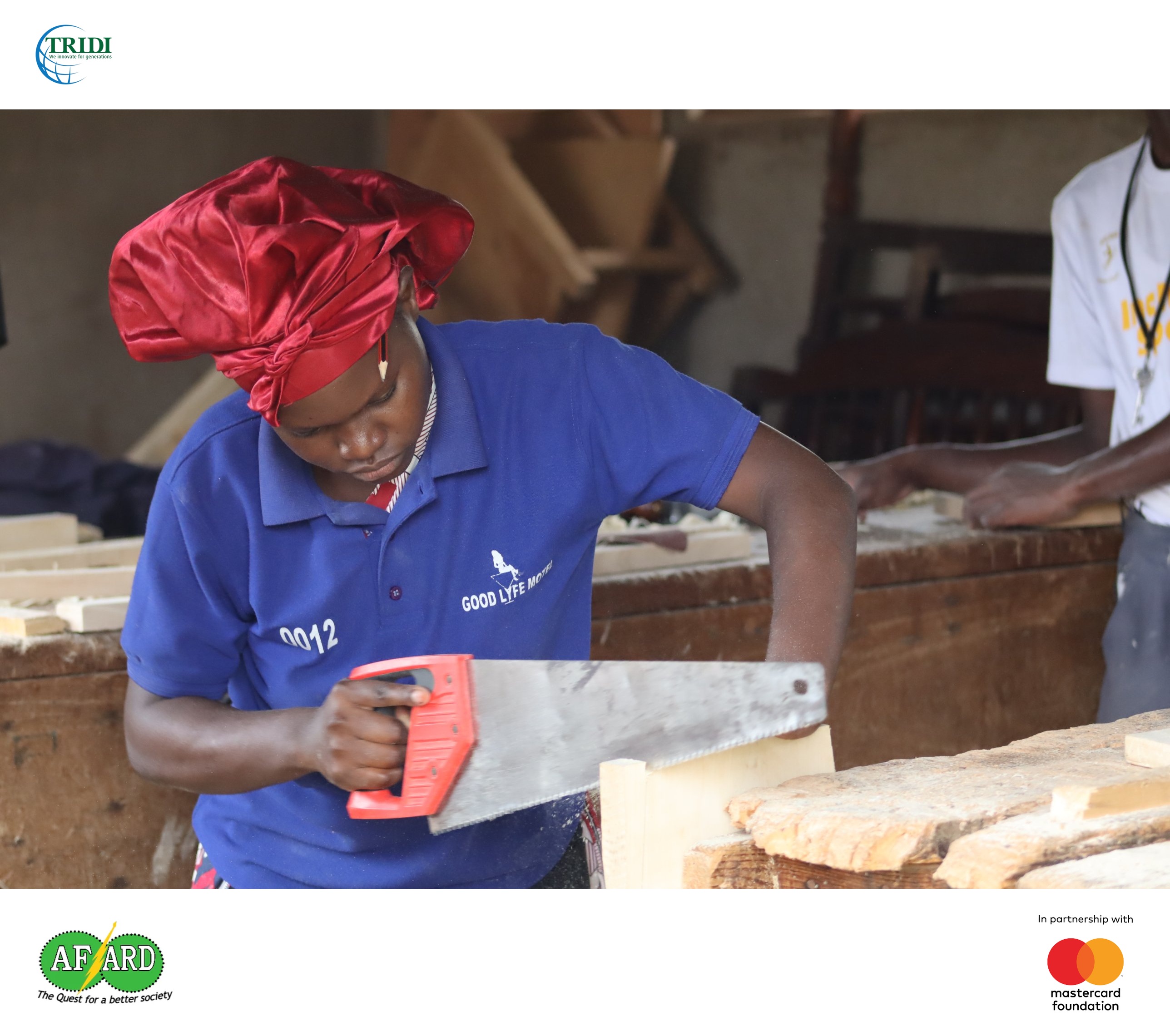
When Jovia Nambajwe chose to pursue vocational training in carpentry, she was not deterred by the fact that it was traditionally a male-dominated occupation. She was driven by something more important; an interest in acquiring practical skills, learning how to make furniture and building her future.
Today, Jovia is the only female trainee among five males in the carpentry course at the Uganda National Association of the Deaf (UNAD), where she is developing skills in making various furniture products under the Sustainable Inclusive Youth Employment Pathways (SIYEP) programme.
Her journey is an example of what happens when young women are given the opportunity to explore occupations beyond traditional gender expectations and the support to develop their abilities.
Choosing carpentry against the odds
Jovia says her decision to join UNAD was driven by a desire to acquire vocational skills. Having already developed an interest in practical training, she was excited when she learnt about an opportunity for women with disabilities to access vocational skills development through SIYEP.
“My aim was to learn skills. I made sure I had to get a place where I could learn these skills. Someone told me about this opportunity, and when she did, I applied. I already had an interest in acquiring carpentry skills. That’s how I joined,” she explains.
“When I reached here, I saw that the UNAD is so inclusive and supportive to young women with disabilities (YWWDs). I’m happy that SIYEP has included YWWDs in vocational skills,” she adds.
Despite having trained for barely three months, Jovia has already acquired practical skills that enable her to make different furniture products.
During the SIYEP institutional skills competitions at UNAD on 13 November 2026, she demonstrated her carpentry abilities by making a table within three hours.
Her instructor, Mr Tembo Zuberi, says she has demonstrated a strong interest in learning and an impressive ability to put instructions into practice.
“I have taught her since inception, and I have been assessing her step by step on how she is doing her work. She is interested. When I teach her something and the next time I give her an exercise, I see that she does it very well,” he says.
He cited measuring and cutting among the tasks she has learnt, adding that she grasps instructions quickly and often takes extra time to learn from other trainees.
He was particularly impressed by her performance during the competition, noting that she completed the table within the three-hour exercise period.
“In this competition, she has worked within three hours. She has made this thing [table] within three hours, and it is a nice thing. She has done well within this limited time,” he said.
He says her products are not only learning exercises but also have commercial potential. He recalls that one of her previously made products was purchased by a customer at UGX
25,000.
“Her products are of good quality and can be sold. They can be marketed outside there,” he adds.
More time for training
While Jovia has made encouraging progress, she concurs with her instructor that more training time is necessary for her to acquire a broader range of carpentry skills.
“Three months have not been adequate for more practical skills. I request TRIDI to sponsor me for three more months so that I complete six months. There, I will learn more things in carpentry,” she says.
Jovia believes that more training time would enable her learn how to make beds, wardrobes, cupboards and more products.
“For most of the students here, we teach them for around six months and more. She has learnt a few things. I would like her to learn more. In carpentry, we learn things step by step. We cannot learn everything within a short time,” he says.
“She keeps asking me how to make this and how to make that. I see that she has more interest because each and every time, she keeps inquiring from me. I would like to request that she is given more time to learn,” he adds
Jovia shares the same concern. As her current training period approaches its conclusion in December 2026, she hopes to receive an additional three months to complete six months of training.
TRIDI’s commitment to supporting women in male-dominated trades
The concern raised by Jovia and her instructor is recognised within the SIYEP programme’s approach to supporting young women in occupations traditionally dominated by men.
Ms. Jessica Nabulo, a Monitoring, Evaluation, Accountability and Learning (MEAL) Officer at TRIDI, explains that SIYEP scholarships are structured to run for between three and six months, depending on the training needs and progress of the participants. She says TRIDI will engage UNAD to ensure that the learner receives the additional training time.
“For this particular student who is doing carpentry, we are definitely going to engage administration, because the funds that we are given are supposed to take them for six months,” she says.
She says learners undertaking male-dominated courses shall be supported to undertake the full six months of training.
“Our scholarship is for three to six months, and that is the standard that we give to all TVETs. We agreed that when we give a student a scholarship in a male-dominated course, they should be able to go for six months,” she says.
According to Ms. Nabulo, while some learners may be ready for assessment after three months, those who require more time shall be supported to complete their training before being assessed.
This commitment reflects the importance of tailoring skills development support to the requirements of different trades, particularly where learners need adequate time to build confidence and competence in non-traditional occupations.
From vocational skills to owning a business
Jovia’s ambitions extend beyond completing her training. She envisions a future in which she can use her skills to establish her own workshop and generate income.
Interestingly, carpentry is not the only vocational skill she has acquired. She has also trained in tailoring and can make blouses, different designs of dresses and men’s shirts.
Her ambition is to combine both skills by establishing a tailoring shop alongside a carpentry workshop.
“I would like to balance, to do tailoring, and also open up my own tailoring shop and my workshop,” she says.
However, she recognises that turning her skills into a sustainable livelihood will require more than technical knowledge. She hopes TRIDI can connect her to employment opportunities or support her with start-up kits.
Her request highlights an important part of the transition from training to work: ensuring that young women have access to the right start-up kits, opportunities and market connections needed to put their skills to productive use.
Beyond breaking stereotypes
Through SIYEP, TRIDI is partnering with 23 vocational training institutions to skill 23,000 young women, including young women with disabilities.
Jovia’s experience at UNAD demonstrates that with access to right training, supportive instruction and sufficient time to practice, young women can develop competencies in occupations that have long been dominated by men.
UNAD’s Centre Manager and SIYEP Coordinator, Ms. Rebecca Nankinga, pointed to Jovia’s progress as an inspiring example for other girls at the centre.
“One particularly inspiring example is a young girl undertaking carpentry. She did an excellent job demonstrating that girls can also excel in trades that are traditionally dominated by men,” she says.
“We want to encourage more girls and young women with a hearing impairment to explore different vocational fields, including carpentry and other technical trades, without being
limited by gender stereotypes. What matters is their interest, ability and the opportunity to learn,” she adds.
Background
SIYEP is a five-year initiative led by the Agency For Accelerated Regional Development (AFARD) and partners in partnership with Mastercard Foundation. TRIDI, one of the eight partners, is implementing innovative skills development interventions through collaborating with 23 Technical Vocational Education Training Institutions across Central, Eastern and Northern Uganda regions.