


How TRIDI’s National Business Incubation and Post-Competition Department Is Turning Skills into Opportunity
By: Daniel Mushikoma
National Business Incubation and Post-Competition Officer-TRIDI
Beyond the competition: building pathways that last
For many young women, acquiring a vocational skill is a significant achievement. But at the Tropical Institute of Development Innovations (TRIDI), the question does not end with “What skill have you acquired?”
The more important question is: “What happens next?”
This question sits at the heart of the National Business Incubation and Post-Competition Department and its contribution to the Sustainable Inclusive Youth Employment Pathways (SIYEP) programme.
SIYEP is designed to equip young women with market-relevant technical, vocational, entrepreneurship, digital and soft skills while creating pathways towards work and sustainable livelihoods. TRIDI’s role extends beyond training and skills competitions to helping young women transform their competencies, ideas and products into viable economic opportunities.
This is where the National Business Incubation and Post-Competition Department becomes critical.
The Department provides the bridge between competence and commercialisation, competition and enterprise, training and work.
Making competition a beginning, not an end
Skills competitions are often viewed as moments of recognition—the stage where the best performers are identified and celebrated.
Under SIYEP, however, competition is part of a much larger journey.
TRIDI’s institutional skills competitions are designed to test practical competence, improve confidence, strengthen product development and prepare young women for wider employment opportunities. Participants who perform strongly can progress through institutional, regional and national levels, with opportunities to compete internationally.
But what happens to the young woman whose competition journey ends at the institutional or regional level?
This is precisely where post-competition support matters.
Rather than allowing skills, creativity and promising products to stop at the competition arena, TRIDI’s approach seeks to identify opportunities for further development, mentorship, product improvement, enterprise development and linkages to institutions that can provide additional support.
The competition identifies potential. Incubation develops that potential. Post-competition support helps connect it to opportunity.
From a product on the competition table to a product in the market
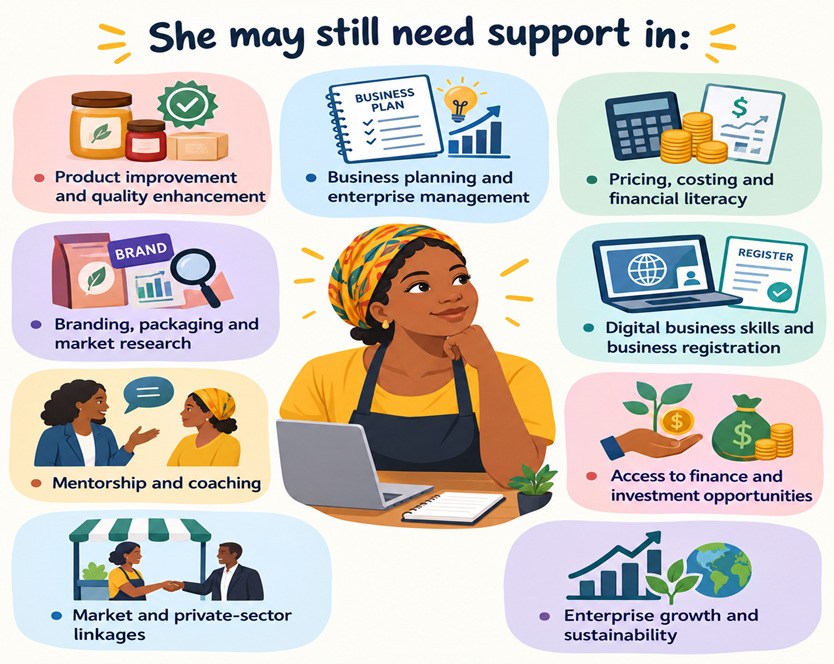
One of the central challenges facing young entrepreneurs is the transition from making a product to building a business around that product.
A young woman may know how to sew a garment, fabricate a metal product, process an agricultural commodity or provide a digital service. Yet technical competence alone does not automatically create a sustainable enterprise.
Taking the incubation mindset across Uganda
SIYEP is not a programme confined to TRIDI’s campus in Mukono. Its implementation is unfolding across different regions and institutional contexts, requiring approaches that respond to local realities.
TRIDI’s regional engagements have demonstrated this clearly.
- In Acholi, for example, work at Kalongo Technical Institute and Kilak Corner Technical Institute brought together instructor training, gender and safeguarding, sexual and reproductive health and life skills, profiling, scholarship systems and institutional partnerships. Sixty tutors were trained across the two institutions, while 215 young women were profiled and enrolled, and two scholarship committees were established.
- At the New Uganda Youth Development and Training Centre (NUYDC), the programme combined technical training with systems that enable young women to participate effectively, including gender, safeguarding, disability inclusion, life skills, financial literacy, and digital training.
- At Bulemeezi Skills and Talent Development Centre, 242 young women were profiled and enrolled, while the institution’s experience highlighted both demand for training and the need for infrastructure and institutional capacity to respond to that demand.
These experiences provide an important lesson for business incubation:
An enterprise pathway cannot be designed from the office alone. It must listen to the young person, the training institution, the community, the market and the realities of each region.
Building the missing bridge between skills and markets
Perhaps one of the most important insights emerging from SIYEP implementation is that training is only one part of an employment pathway.
TRIDI’s experience at Amelo Technical Institute in Adjumani illustrates this challenge. The rollout raised practical questions about equipment, personal protective equipment, unreliable electricity, product markets and how trained young women can connect to customers and opportunities.
These questions are directly relevant to business incubation.
If a young woman has a skill but lacks tools, her productivity is constrained.
If she has a product but no market, her enterprise may struggle.
If she has customers but cannot manage cash flow, growth becomes difficult.
If she has an enterprise but cannot access networks, finance or technical mentorship, sustainability becomes uncertain.
The role of the National Business Incubation and Post-Competition Department is therefore to help close these gaps.
Incubation as a pathway to dignified work
The Department’s work under SIYEP can be understood as a pathway with several connected stages:
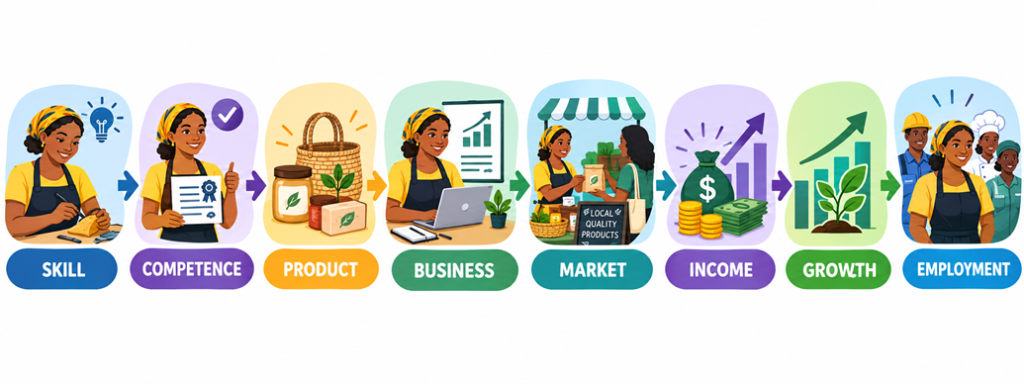
The purpose is not to move every young woman through an identical route. Some may enter employment. Others may establish enterprises. Others may improve existing businesses or become suppliers within value chains.
What connects these pathways is the need for practical support after training.
This is consistent with SIYEP’s wider ambition to equip young women in Uganda with market-relevant technical, vocational, soft and entrepreneurship skills and support pathways towards work and decent, fulfilling employment.
Making inclusion part of enterprise development
The word inclusive in SIYEP is not simply a programme description. It carries an important responsibility for the incubation function.
Young women from rural communities, young women with disabilities and those entering traditionally male-dominated trades may face additional barriers when moving from training into enterprise or employment.
TRIDI’s SIYEP model recognises young women with disabilities and participants from rural communities, while incorporating disability inclusion, gender and safeguarding into programme implementation.
For the National Business Incubation and Post-Competition Department, this means designing enterprise support that considers the person behind the business idea.
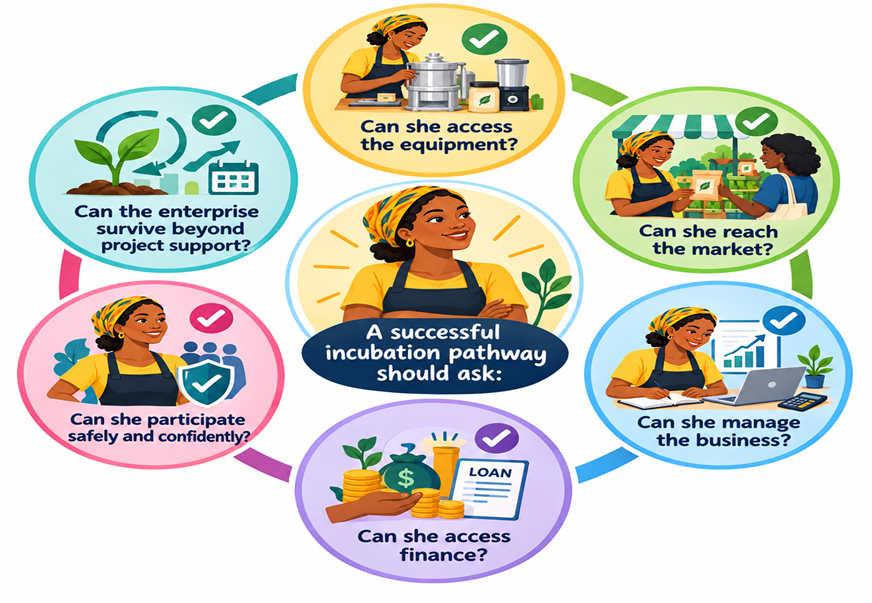
These are not peripheral questions. They are central to sustainable enterprise development.
Partnerships: the force behind sustainable pathways
No single department or institution can create employment pathways alone.
SIYEP brings together TRIDI and its programme partners, with support from the Mastercard Foundation. The programme’s scale and geographic reach demonstrate the importance of partnerships in building youth employment ecosystems.
For the National Business Incubation and Post-Competition Department, partnerships create opportunities to connect young women to training institutions, mentors, private-sector actors, markets, financial institutions, business development service providers, technology and innovation networks, government and local leadership, and potential customers and investors.
The Department’s role is therefore not only to incubate businesses, but also to help build the ecosystem in which those businesses can survive and grow.
From National program to local enterprise
The success of SIYEP will ultimately be measured not only by the number of young women trained or the number of competitions conducted, but by what happens afterwards.
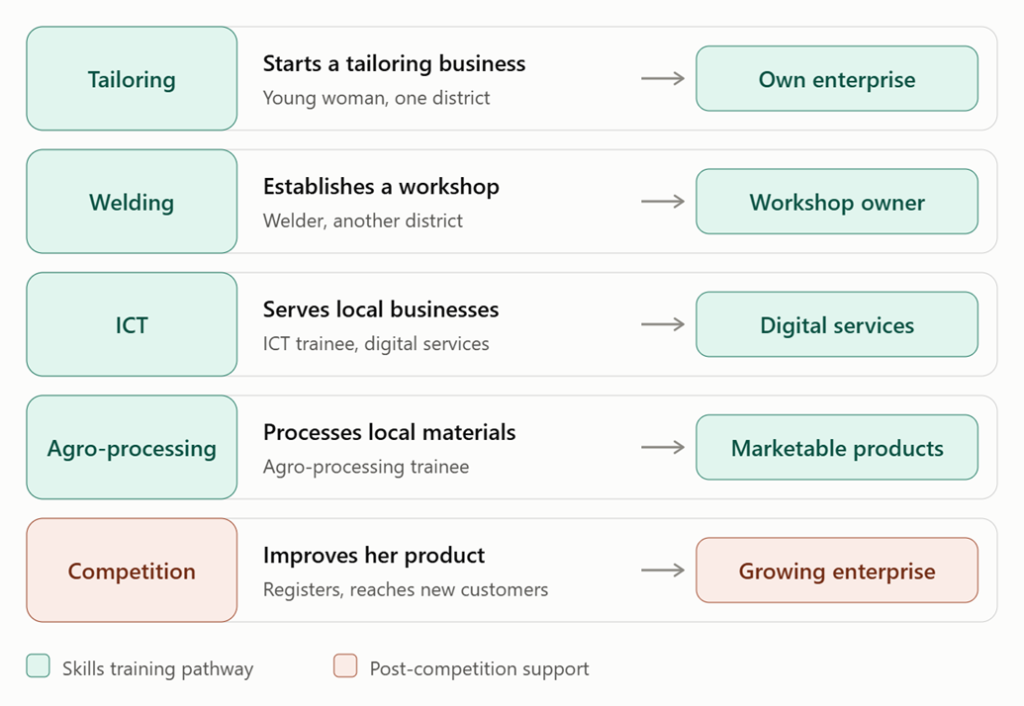
These are the pathways through which programme investment becomes visible in communities.
The National Business Incubation and Post-Competition Department is committed to making this transition possible by ensuring that talent does not remain talent, skills do not remain skills, and competition does not remain competition.
They must become opportunity.
The next chapter: building enterprises that can stand on their own
As SIYEP implementation continues across Uganda, TRIDI’s challenge is evolving.
The question is no longer only whether young women can be reached and trained. The next question is whether the systems around them can help them move from training to opportunity.
TRIDI has identified the need to strengthen TVET institutions, instructors, young women, communities, industry, markets and partnerships so that skills can connect to real economic opportunities.
This is the space in which the National Business Incubation and Post-Competition Department will continue to play its part.
Our ambition is simple but significant:
To make the journey from skill to enterprise clearer, from enterprise to market stronger, and from competition to sustainable livelihood more achievable.
Because the real measure of a successful skills programme is not only what a young woman can do after training.
It is what she can build, earn, employ, innovate and sustain with that skill.
NATIONAL BUSINESS INCUBATION AND POST-COMPETITION DEPARTMENT
Tropical Institute of Development Innovations (TRIDI)
From Skills. To Enterprise. To Opportunity. To Sustainable Employment.